
Are you looking to build muscle and achieve your fitness goals? Whether you’re a beginner or an experienced lifter, a well-structured workout plan is essential for success.
Understanding the science behind muscle growth is crucial. Proper resistance training stimulates hypertrophy through microscopic tears in muscle fibers, leading to increased strength and a more toned physique.
By incorporating effective exercises into your routine and focusing on progressive overload, volume, intensity, and recovery, you’ll be on your way to achieving your fitness goals.
The Science Behind Muscle Growth
To effectively build muscle, it’s essential to understand the underlying science. Muscle growth occurs when you challenge your muscles through resistance training, causing microscopic tears in the muscle fibers.
How Muscles Respond to Resistance Training
When you engage in strength training, your muscles undergo stress, leading to damage at the cellular level. As your body repairs these tissues, they become stronger and larger. This process is fundamental to building bigger muscles over time.
The Role of Protein Synthesis in Muscle Development
Protein synthesis is crucial for muscle recovery and growth. After a workout, your body uses dietary protein to repair and build new muscle tissue. Adequate protein intake is essential to support this process, ensuring that protein synthesis exceeds protein breakdown for net muscle growth to occur.
As noted by experts, “Your body’s protein synthesis rates remain elevated for 24-48 hours after an intense resistance training session, highlighting the importance of consistent nutrition during this window.” This emphasizes the need for a balanced diet that supports your training regimen.
Key Benefits of Building Muscle Beyond Aesthetics
Building muscle goes beyond just looking good; it has numerous benefits for your overall health and functionality. As you develop stronger muscles, you’re enhancing not just your physique, but also your overall well-being.
Increased Metabolic Rate and Fat Burning
One of the significant advantages of building muscle is the boost in your metabolic rate. The more muscle mass you have, the higher your resting metabolic rate will be, allowing your body to burn more calories at rest. This can be particularly helpful for fat loss and maintaining weight loss over time.
Improved Bone Density and Joint Health
Resistance training and muscle building also contribute to improved bone density, reducing the risk of osteoporosis and fractures. Additionally, stronger muscles around your joints provide better support and stability, potentially reducing the risk of injury and improving overall joint health.
Enhanced Functional Strength for Daily Activities
The strength you gain from muscle building translates directly into improved performance in everyday activities. From carrying groceries to climbing stairs, or even playing with your children, having stronger muscles makes these tasks easier and less strenuous. This functional strength enhances your ability to generate force efficiently, improving your overall quality of life.
Essential Principles of Effective Muscle-Building Exercises
To achieve significant muscle growth, it’s crucial to understand the fundamental principles that drive effective muscle-building exercises. A well-structured training program is essential for maximizing gains.
Progressive Overload: The Foundation of Growth
Progressive overload is the gradual increase in weight, resistance, or reps over time to challenge your muscles continually. This principle is foundational because it stimulates muscle growth by pushing your muscles beyond their current capacity.

Volume and Intensity: Finding the Right Balance
Balancing training volume and intensity is critical. Volume refers to the total amount of work done, while intensity is about the difficulty of that work. Finding the right balance between the two is key to avoiding plateaus and ensuring continuous progress.
Rest and Recovery: When Muscles Actually Grow
Muscles don’t grow during workouts; they grow during the recovery period between sessions. Ensuring adequate rest is crucial for allowing your muscles to repair and grow. This includes getting enough sleep, as growth hormone secretion peaks during deep sleep phases.
By understanding and applying these principles, you can create a more effective muscle-building program that yields real results.
Optimal Training Frequency for Maximum Muscle Gains
To optimize your muscle-building journey, understanding the ideal training frequency is crucial. The frequency at which you train each muscle group significantly impacts your progress and overall muscle development.
How Many Days Per Week to Train Each Muscle Group
Research indicates that a muscle needs to be worked at least two or three times a week to stimulate growth. This means you should aim to hit the gym at least twice a week, with a maximum of six times. It’s tempting to train every day, but rest days are crucial for building muscle as they allow for recovery.
Signs You’re Overtraining or Undertraining
It’s essential to recognize the signs of overtraining and undertraining. Overtraining can be identified through symptoms like persistent fatigue, decreased performance, and disrupted sleep patterns. On the other hand, undertraining might be indicated by quick recovery, plateaued progress, and feeling undertaxed during sessions. Proper recovery is key to avoiding these issues and ensuring your muscle growth is on track.
- Watch for signs of overtraining such as persistent fatigue and decreased performance.
- Conversely, if you recover too quickly or feel underchallenged, you might be undertraining.
- Proper training volume should challenge you without depleting your energy completely.
By paying attention to your body’s response to your workouts and adjusting your training frequency accordingly, you can optimize your muscle gains.
Compound vs. Isolation Exercises: What’s More Effective?
Compound and isolation exercises serve distinct purposes in a muscle-building regimen. Compound exercises, such as squats and deadlifts, work multiple muscle groups simultaneously, while isolation exercises, like bicep curls, target specific muscles.
Benefits of Multi-Joint Movements
Multi-joint movements, or compound exercises, are effective for building overall muscle mass because they recruit a large number of muscle fibers. Exercises like squats, deadlifts, and bench presses are staples in many workout routines due to their ability to stimulate multiple muscle groups at once. This not only saves time but also promotes a more balanced physique.
When to Incorporate Single-Joint Exercises
Isolation exercises are valuable for targeting specific muscles that may be lagging or need additional work. They can help correct muscular imbalances, improve mind-muscle connections, and enhance the overall aesthetic of your physique. For instance, leg extensions can help strengthen the quadriceps, while lateral raises can isolate the deltoids. Incorporating these exercises towards the end of your workout can help fine-tune your training.
- Target specific muscles that need extra attention.
- Correct muscular imbalances and prevent injuries.
- Enhance the overall appearance of your physique.
By combining compound exercises with strategic isolation work, you can create a well-rounded training program that addresses your overall fitness goals.
The Most Effective Muscle-Building Exercises by Body Part
When it comes to muscle building, understanding the most effective exercises for different body parts is key to a successful workout routine. This knowledge allows you to tailor your training program to your specific goals, whether you’re focusing on upper body strength, lower body power, or core stability.
Upper Body Power Moves
For the upper body, exercises like the bench press and rows are highly effective. The bench press targets the chest, shoulders, and triceps, while rows work the back and biceps. Incorporating these compound exercises into your routine can significantly enhance upper body strength.
Lower Body Strength Builders
The squat is a foundational lower body exercise that targets the quads, glutes, and hamstrings. Maintaining proper form is crucial; ideally, you should look like you’re sitting in a chair at the bottom of the squat, with your heels on the ground and hips back. This proper form ensures you’re effectively building strength in your lower body.
Core-Strengthening Essentials
Effective core training goes beyond simple crunches, incorporating exercises that challenge the entire midsection. Planks and their variations build isometric strength throughout the core, while cable woodchops and Pallof presses develop rotational stability. These exercises are crucial for a strong, stable core, which is the foundation for all other lifts and improves overall body performance.
Free Weights vs. Machines: Choosing the Right Equipment
Understanding the differences between free weights and machines is essential for effective muscle building. Both types of equipment have their unique benefits and can be used to achieve your fitness goals.
Advantages of Barbell and Dumbbell Training
Free weights, such as barbells and dumbbells, offer a range of benefits, including improved muscle coordination and balance. They allow for a more natural movement pattern, engaging multiple muscle groups simultaneously. This can lead to increased overall muscle development and functional strength. For example, exercises like squats and deadlifts work multiple joints and muscle groups, making them highly effective for building overall strength.
When Machine Exercises Make More Sense
Machines can be particularly useful for beginners or those looking to isolate specific muscles. Resistance machines follow a fixed movement path, making it easier to perform an exercise without relying on technical knowledge of the form. This can help minimize the risk of injury and ensure that the right muscles are engaged. Machines are also beneficial for advanced lifters who want to target specific muscle groups without the complexity of free weight exercises.
Some key benefits of using machines include providing a controlled environment, effectively targeting specific muscles, and offering safer alternatives when training around injuries or to failure. By incorporating machines into your workout routine, you can add variety and complement your free weight training for more comprehensive muscle development.
Designing Your Workout Split for Optimal Results
Designing an effective workout split is crucial for achieving your muscle-building goals. A well-structured workout routine helps ensure that you’re training each muscle group adequately without overdoing it.
Full-Body Workouts: Pros and Cons
Full-body workouts involve training all major muscle groups in a single session. This approach can be beneficial for those with limited time or who are just starting out. However, it may not allow for the same level of intensity and volume as other splits. Pros include increased overall muscle stimulation and improved endurance, while cons include potential overtraining and limited exercise variety.
Push/Pull/Legs Split Explained
The Push/Pull/Legs (PPL) split is a popular routine that divides workouts into three categories: pushing muscles (chest, shoulders, triceps), pulling muscles (back, biceps), and legs (quads, hamstrings, glutes). This split allows for a good balance between training frequency and recovery. It’s a 6-day split that can be adapted to different training frequencies.
Upper/Lower Body Splits for Balanced Development
Upper/lower splits divide your training into sessions focusing on all upper body muscles and all lower body muscles. This approach typically involves 4 weekly sessions, allowing each muscle group to be trained twice per week with adequate recovery time. It strikes an excellent balance between training frequency, volume, and recovery for intermediate lifters. You can expect to see balanced development across all muscle groups with this routine.
Sets, Reps, and Rest Periods: The Perfect Formula
Understanding the perfect balance of sets, reps, and rest periods is crucial for achieving your muscle-building goals. The interplay between these three factors determines the effectiveness of your workout routine.
Hypertrophy-Specific Training Parameters
For muscle hypertrophy, focus on performing 3-5 sets per exercise. The number of repetitions should be between 8-12, which is considered the hypertrophy range. Using a weight that allows you to complete the given number of repetitions with proper form is essential.
Rest Intervals for Maximum Muscle Stimulation
The length of rest periods between sets significantly impacts muscle growth. For hypertrophy-focused training, rest for 60-90 seconds between sets. This allows for sufficient recovery while maintaining elevated metabolic stress. For heavier compound movements, consider longer rest periods of 2-3 minutes to maintain proper form.
Tailoring your rest periods and sets can significantly enhance your workout’s effectiveness. Techniques like supersets and drop sets can also be used to manipulate rest periods and increase training density.
Nutrition Fundamentals for Muscle Growth
Proper nutrition is the backbone of successful muscle growth, complementing your workout routine. To build muscle, you need to fuel your body with the right nutrients at the right time, ensuring you have enough energy for your workout.
Protein Requirements for Building New Muscle
Adequate protein intake is crucial for muscle development. Consuming 1.2 to 1.6 grams of protein per kilogram of body weight daily supports muscle growth and repair.
Caloric Surplus: How Much Is Enough?
To build muscle, you need to be in a caloric surplus, consuming more calories than you burn. Aim for an additional 250-500 calories above your maintenance level to support muscle growth.
Timing Your Meals Around Workouts
Eating carbohydrates before your workout can boost your energy levels. Consuming protein within 2 hours after your workout
Sample 4-Week Muscle-Building Workout Plan
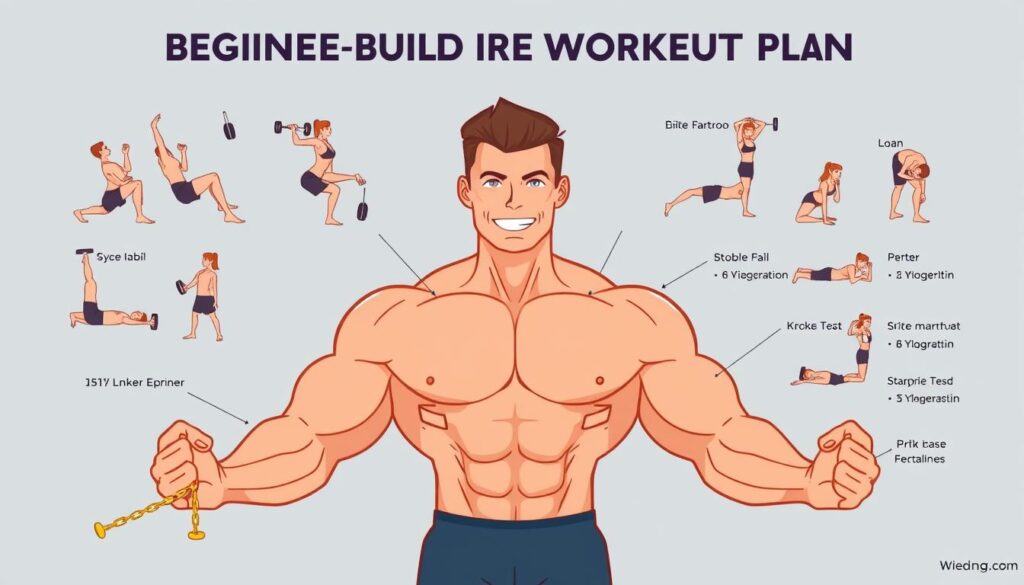
Here’s a sample 4-week workout plan designed to help you build muscle and increase strength. This plan follows a push/pull/legs split, with six workouts per week.
Week 1-2: Foundation Phase
During the first two weeks, you’ll focus on building a foundation of strength and muscle mass. You’ll perform 3-4 sets of 10-15 reps for each exercise, using weights that challenge you but allow for proper form.
As you progress, you’ll start to feel the effects of increased muscle stimulation, setting the stage for further growth.
Week 3-4: Progressive Phase
In weeks 3-4, you’ll increase weights by approximately 5-10% while reducing repetition ranges to 8-12 per set. The workout split remains the same, but exercise intensity increases through both heavier weights and shorter rest periods.
You’ll maintain the same core compound movements but may add advanced techniques like supersets or drop sets to isolation exercises, performing 3-4 sets with optimal reps.
Tracking Progress and Adjusting Your Approach for Long-Term Success
Effective muscle building is a multifaceted process that involves consistent training, balanced nutrition, and adequate recovery. To achieve your fitness goals, it’s crucial to track your progress and make adjustments as needed over time.
Consistent tracking of key metrics, including workout performance, body measurements, and progress photos, is essential for long-term success. You can expect to see noticeable muscle gains within 6-12 weeks of consistent training. When progress stalls, systematically adjust one variable at a time to get back on track.
Periodization strategies that cycle between different training emphases help prevent plateaus and allow for continued progress over months and years. Building muscle takes time and consistency, so focus on developing a sustainable routine that you can maintain in the long term to effectively build muscle and support your overall muscle building goals.






No comment